
New Year's Eve
Last updated
New Year's Eve is the last day of the year, 31 December. In 2026 it is a Thursday in week 53. It is not a public holiday, but most people finish early and at midnight New Year's Day takes over as a public holiday.
Countdown to New Year's Eve
New Year's Eve 2026 falls on a Thursday in week 53. It is not a public holiday, but New Year's Day is.
Short answer
- Date
- 31 December 2026, a Thursday
- Week
- Week 53
- Public holiday
- No, but New Year's Day is
- Countdown
- To midnight, when the new year starts
- Chimes
- SVT1 broadcasts from Skansen
- Systembolaget
- Shorter hours on New Year's Eve
New Year's Eve and New Year's Day
| Year | New Year's Eve | New Year's Day |
|---|---|---|
| 2026 | ||
| 2027 | ||
| 2028 | ||
| 2029 | ||
| 2030 | ||
| 2031 | ||
| 2032 | ||
| 2033 | ||
| 2034 | ||
| 2035 |
Date, weekday and week number
New Year's Eve is always 31 December, the last day of the year. The weekday shifts one step later each year and two after a leap year, since 365 days do not add up to whole weeks. In 2026 it is a Thursday in week 53, in 2027 a Friday and in 2028 a Sunday. The next time it lands on a Thursday is 2037. Week 53 only exists in some years, so 31 December usually sits in week 52.
Not a public holiday, yet almost everyone is off
In the calendar New Year's Eve is an ordinary weekday. It is New Year's Day, 1 January, that is a public holiday, and that is where the time off comes from. Most people still finish early: many workplaces give a half day or close completely, and many collective agreements shorten the day because New Year's Eve comes before a public holiday. Shop staff, chefs, taxi drivers and care workers often work, and anyone on the night shift can count on the busiest evening of the year.
Fireworks and bangers
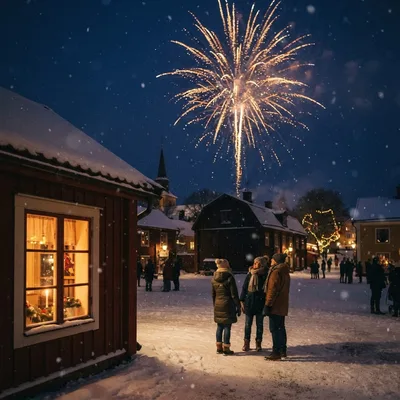
Fireworks rules differ between municipalities, so the municipality's word applies where you live. Many have places and hours where firing is not allowed, and around midnight it is at its loudest. Dogs, cats and horses get frightened, so some people walk the dog earlier in the evening and keep the cat indoors. Never fire at houses, cars or people, and keep children at a distance.
The chimes and the new year
When the clock strikes twelve the new year is here. SVT1 usually broadcasts the chimes from Skansen with the bells and the celebration, and shortly afterwards many people go outside for the fireworks. At midnight the date changes day and year at the same time, so 31 December becomes 1 January. Some watch the clock on their phone, others listen for the bangs and count the last seconds together.
Food, drink and the shape of the evening
Most people start the evening with a late dinner, often several courses, and the champagne is opened when the clock strikes twelve. Some have people over first and then go out, others celebrate at home with children and eat earlier. Promising yourself something for the new year is an old tradition: some stop smoking, others start exercising, and most promises last a few weeks.
The Christmas break and early January
New Year's Eve falls in the middle of the Christmas break, so schools are closed. When the spring term starts differs between municipalities: some begin on 7 or 8 January, others a few days later. After-school care and preschools often keep limited hours between Christmas and New Year. The school holiday pages here list the Christmas break dates for your municipality.
Common questions about New Year's Eve
No. 31 December counts as an ordinary weekday under the Swedish Public Holidays Act. It is New Year's Day, 1 January, that is a public holiday, followed by Epiphany on 6 January. Many workplaces still close early, and some give a half day.
The municipality decides, and many have local rules about where and when fireworks may be used, so it is the municipality's word that applies where you live. Remember that dogs, cats and horses get frightened, that children should keep their distance and that firing at houses, cars or people is never allowed.
At midnight between 31 December and 1 January, Swedish time. That is when we enter a new calendar year, and New Year's Day is a public holiday. So 2027 begins at 00:00 on 1 January 2027.
New Year's Eve 2026 is a Thursday in week 53. In 2027 it is a Friday and in 2028 a Sunday. The date is always 31 December, only the weekday and the week number move.
New Year's Eve falls in the middle of the Christmas break, and the municipality decides when the spring term starts. Some schools begin on 7 or 8 January, others a few days later. The school holiday pages here list the Christmas break for every municipality.
Most people have a late dinner with friends or family and watch the chimes on SVT1 at twelve. Shortly after midnight many go outside to see the fireworks and wish the neighbours a happy new year. New Year's Day is quiet: it is a public holiday and many shops stay closed.